In Search of Philanthropic Culture. And Purple Unicorns

10394488_10204132557901150_5806912981899308065_n

In her inspired call for increased organizational resources and deeper commitments to the fundraising process, Stef Krievins of Radiancy Coaching Partners righty articulates the limits of what fundraisers can be expected to accomplish without a lasting commitment to philanthropic culture, board engagement and executive leadership similarly invested in the same effort and on the same page. 

I sincerely believe that this gap of expectations between fundraising staff and organizational leadership is a major contributor of short tenures in our profession. We are all looking for the Purple Unicorn of career fulfillment and professional success.

This Organizational Ideal sounds quite irresistible. Adequate staffing and training budgets. Engaged volunteers proactively making connections on our behalf. Executive leadership engaged in the work. But you know what? It does not exist as an Ideal, not at least in any organization I know about.

The largest performing arts organization in the world is the Metropolitan Opera, with a $300million+ annual budget and a Dream Team Board of Directors in the most affluent market imaginable. And yet? They have had in recent years a giant and ongoing leadership and fundraising problem that almost sent the organization to bankruptcy. I promise that at the Met the fundraising staff grumbles about the Board and the Board grouses about the fundraising staff. So it is everywhere.

Building a Philanthropic Culture sounds lovely. But who should lead it? If fundraising is truly a Profession, it must be the Fundraiser who sets the example, who recruits and trains the right volunteers, inspires the board, leads up to the CEO and others in the organization. Why? Because that is the Job.

Let’s compare the Professional Fundraiser who skates every 18 months to the next gig, when times get tough, with other sorts of professionals. Let’s begin with Physicians. Doctors heal people, and for the most part are overwhelming successful in keeping most of us healthy (or patched up) despite extraordinary barriers: private insurance, regulatory red tape, threats of malpractice, downward pressure on resources and income, and on and on.

Doctors have challenging work. And yet the vast majority of them put their head down and do their business of healing. Compassionately, for the most part, despite the obstacles, stress, and high stakes. Because that is the Job.

A Doctor is a Professional. So, too, is a Teacher. Teachers have the most challenging obstacles imaginable with a lack of resources and support starting the long list. And yet Teachers teach, every day. I look back at a lifetime of education from small pants to graduate school and competent, professional teachers (and occasionally inspiring) put me where I stand.

Are there difficult obstacles for fundraisers? There are. But this cannot stop us. Board members won’t help? Find someone who can. Board members should be recruited from the Development committee. Boss doesn’t know how to raise cash? Teach them. Take them with you to $5,000 low carb lunch meetings. No one wants to pay for professional development? Find a mentor. Your older colleagues want to see your professional success. Funders don’t get it? Cultivate them in your good work and by casting a vision.

Fundraising is a noble calling that I’ve devoted nearly 20 years of my life to for some wonderful organizations. But if we are to truly call ourselves professionals we need to own our work, lead our colleagues and volunteers, commit ourselves fully to the organizational challenges we face, and quit looking for that Purple Unicorn of the next job, the easier path, a little more money, a windowed office.

Inspire. Lead, Ask for cash. Do your Job!

This is the third part of an ongoing conversation between the artful fundraiser and Radiancy Coaching Partners. Follow along at RCP for Part Four and share your thoughts in the comments tab below. 

Posted in Board Development, Fundraising, Leadership, Performing Arts, Philanthropy, Uncategorized | 1 Comment

Is Fundraising a Profession?

12274361_10208371644915676_118399368419348464_n

Stef:

Thanks for inviting me to chat about the staffing and organizational challenges of the typical non-profit. I’ve been a fan of your work at Radiancy Coaching Partners for a long time and your passion for social justice.

Where to begin? With something funny of course.

My favorite blogger (non-profits with balls) breaks down the non-profit realities for us recently in tragic fashion. If there is a more accurate, amusing, and honest summation of our work in non profits I don’t know it. My favorite? The employee benefits program that involves taking home leftover cheese and half drunk bottles of wine from donor receptions. This is the truest of the true. At my last day job I lived off of donor cheese and Diet Coke for several months and my friends confided in me that my complexion was pasty and worrisome.

I’ve been thinking a lot lately about the nature of fundraising as a profession. Fundraising as a career path is much like that of a basketball coach. Have some initial and early success in your work and you will be moved quickly up the food chain by either your organization (unlikely) or by the competition. Have a bad quarter, irritate one single board member, or get caught up in a staff transition plan by the new CEO and it is back on the job market.

And no one seems to mind. I see employers hire fundraisers who’ve left four jobs in five years. What to do you think is going to happen this next time around? That your candidate magically commits to you as stop number five?

So for most fundraising “professionals” in a management position, it is stay a year or two, at most, and then off to the next thing. Regardless of the economic conditions, fundraising tenures are holding steady at 18-24 months and have been for many years. That’s two years to establish deep and trusting relationships with donors, to learn an organization culture, to pursue ambitious goals, to be a change agent for the good of humanity.

That’s a joke, and it is not a funny one.

There are many reasons for this constant turnover, I grant you that. Often unrealistic expectations, shabby work-life balance, inadequate training and little professional development, as a start to a long list.

Is fundraising truly a profession? Increasingly, I am beginning to wonder. In considering our dialogue about the state of non-profits, I googled the term “professional” and the consensus definition is something like, “Person formally certified by a professional body of belonging to a specific profession by virtue of having completed a required course of studies and/or practice. And whose competence can usually be measured against an established set of standards.

A lot to unpack here. Are fundraisers consistently certified or credentialed? No, not even close. The baseline for evaluating fundraisers generally involves, “Would I like to drink a beer with this guy?” or “Will the board members enjoy hanging out with this attractive 20 something woman?” and simplistic, nonsensical interview questions such as, “What’s the biggest gift you’ve ever raised?”

No one knows when what questions to ask potential fundraisers in interview sessions. Why? I believe the staffing churn is so great and has been for so long that employers understand that they probably cannot count on long-term tenure and so see their fundraising staff as replaceable parts for the most part.

Whose fault is this?

If fundraising is a profession (and I am not convinced) then we as professionals need to stop jumping ship at every opportunity. If our work is about developing relationships and lasting impacts, the change needs to start with us as PROFESSIONALS.

As educated and accomplishment fundraisers, we are not victims to management. We can seek out strong organizations with compelling missions and we can develop the fundraising capacity over time. We can be change leaders in our organizations. We can be ambassadors in the community, building connections and relationships. If we are to grow fundraising into a true profession, with high standards of accountability and pride, this change must start with us.

Or we can keep our resumes handy and jump at the next shiny object, for a little more money and some better donor cheese.

This is the first part of an ongoing conversation between the artful fundraiser and Radiancy Coaching Partners. Follow along at RCP for Part II and share your thoughts in the comments tab below. 

Posted in Fundraising, Leadership, Philanthropy | 7 Comments

No More (Cruddy) PayPal Fundraising.

img_3625

I am a sucker for community level fundraising. Kids on Bikes. Science for Kittens. Kale for Veterans. Shelter from the Storm. Supporting small and focused local organizations is one of the most impactful ways to support your community as a citizen. I encourage you to seek out those small organizations in your own community, those working with slim margins for tremendous results. Be generous.

That being said, PayPal is a very cruddy way to fundraise. Perhaps it is my advancing years showing but I have aversion to PayPal. Since turning off my official account I get less spam and phishing attempts in my email. It is not quite a shady service but my friends it is a very much a TRANSACTIONAL one.

Our work in 2016 should be about building philanthropy, making an emotional case to the community about our works and impacts. No one has said this better recently than in Claire Axelrad’s take on Philanthropy. It is a dream worth pursuing and a call to arms by Claire. We need to tighten up our practices. Now.

This week I gave $50 to a wonderful little organization (I am not naming names) doing amazing things in my home city of Indianapolis. What happened? First I get an email “receipt for payment”. Payment? This wasn’t a payment. This was a philanthropic gift to your good work. I make payments to the gas company.

After that I received another, second email as a “Receipt for Your Donation” reconfirming the thing that I just received an email for one minute ago. Nowhere on either communication does the receipt say thank you. Nor does PayPal explain what you are supporting, where to call with questions, what might be next for you as a donor. It is what it is, which is a confusing two step receipt. Just like if I bought some special beef jerky from the web.

This isn’t PayPal’s fault. They offer a low cost service to non-profits for transactions. But gifts cannot be seen as transactions in 2016. What happens after the initial online transaction is presumably up to the organization that received the gift. And that’s usually not much. Maybe a written acknowledgement but often not.

So a donor seeks out the organization, finds the link to give online, puts down a credit card, makes a gift. And the organization cannot be bothered for so much as a proper thank you. I am weary of this treatment.

I dislike PayPal transactions generally (call me old if you want) but if you are going to use PayPal as your fundraising solution you best:

  1. Send an immediate and personal email saying THANK YOU THANK YOU THANK YOU. If I don’t hear from the organization directly I cannot even be sure that my support was received and not in Kenya assisting a Royal Prince to retrieve his lost family fortune from Pirates.
  2. Call every donor who makes a gift and personally thank them. You won’t do this. You won’t. I would do anything to change this but you won’t pick up the phone.
  3. Provide a warm, personalized written acknowledgement letter to the donor. I know some organizations that only acknowledge online gifts by email, assuming the donor has some grand preference against the Postal Service. Donors give in a variety of ways. Thank them properly regardless of their giving vehicle. 

Rethink your PayPal. And Call your Donors.


Posted in Annual Fund, Fundraising, Philanthropy | Tagged , | 3 Comments

Your Incremental (fundraising) Resolutions.

I am going to run a half marathon this year. There are myriad challenges ahead (exercising on the road, approaching middle age, a deep personal commitment to fried chicken) but I’ve done it before, and so I know to view this not as a revolutionary single act but rather as part of a series of modest lifestyle improvements and better habits. Incremental change is often the best and most lasting.

What are your incremental fundraising resolutions for as you anticipate the Marathon of 2016? You could start here:

  1. Commitment to Stewardship. I made around 25 philanthropic gifts in 2015, ranging between $100 and $1,000. I got exactly one thank you call (not for either of my $1,000 gifts nor a $500 gift to my alma mater). I chipped in $100 to a small organization where I am personal friends with the Executive Director and got a form letter thanks with no personal acknowledgement whatsoever. Don’t be an ingrate. This is shabby fundraising. Resolve to make saying Thank You a centerpiece of your fundraising program. Every single day. After you read this, call some year end donors.
  1. Commitment to The Job. The biggest knock against fundraisers is that we, as a profession, are all looking around for the next gig, all the time. It has to stop. Either get out now or commit yourself fully to your work in 2016. If something comes along you cannot pass up, deal with that then. But assume for now that you are going to stay in your job, building on past success and committed to deepening relationships via our $5,000 low carb lunches. Until more of us are committed to longer tenures, I don’t think we can honestly call fundraising a real profession.
  1. Commit to Better Hiring. I appreciate that the job market is tight right now and quality candidates have the upper hand. Good for them. But I do not accept mediocrity in your hires in 2016. Better, truly, to go without than hire a marginal candidate. A cultural organization I know hired a Director of Development with no major gift experience, and on his fourth job in five years, all from unrelated human service work. He does have a lot of twitter followers, though. How well is this going to go do you think?
  1. Commit to a Plan. An annual fund’s (and all other fundraising initiatives) ultimate success is dependent on careful planning and execution, starting in January. Your program is served by consistency and repetition of best practice. So that means Just Saying No to the unplanned Giving Tuesday brainstorm a week before Thanksgiving. Leave improvisation to the Jazz musicians. Use that creativity to inspire your donors in conversation and to cast a vision.
  1. Commitment to Mentorship. We all need a coach or mentor, even those of us whose primary job it is to coach and consult. Co-workers, spouses and friends are all wonderful, of course, but mostly cannot be the impartial ear and advice giver you need. The best professionals I know both seek outside perspective regularly and serve as mentors for others. It works. Work it.
  1. Commitment Not to Take Any Crap from Marketing. Just kidding! This year, how about a simple incremental resolution that communications become integrated to the point that a patron won’t receive two mailings from your organization on the same day? Push it and say the same week? That will be real progress for most non-profits.
  1. Recognize the Opportunity. Let’s get after it friends. Whatever challenges you face this year, no one is going to care at all in 2017 except about your ultimate progress towards fundraising goals. This is the wealthiest moment in the history of the wealthiest country the world has ever seen. Capacity is not the issue. Celebrate your successes. Keep pushing.

I will let you know how my Marathon goes. Go Run Yours.

Posted in Annual Fund, Fundraising, Performing Arts, Philanthropy | Tagged , , | 2 Comments

3 Continents. 2 7th Wonders. 1 Delta Porsche. Postcards from the 168 Flights of 2015. 

IMG_5060

Another lively year of work travel and a record 168 airplane rides, three continents, and far too many airport turkey wraps to mention. 2015 was a trip to India, perspective changing and overwhelming to the senses. The joy of travel is to experience and engage the unknown. Our Guide explained that most Americans don’t get to India until they’ve been to 25 or 30 other countries. Go. Go to India.

The Great Wall of China is extraordinary, particularly on the day we got to visit with clear air, recent snowfall, and a small crowd. Modern China is a peek into our own future, and each and every institution (including the subway) has armed security and a metal detector. Soon it will be in the USA, alas.

IMG_4430

I was part of opening a new theatre in 2015, the result of a successful capital campaign in Omaha, Nebraska. The new BlueBarn Theatre is amazing, the result of a strong artistic vision leading a dynamic group of collaborators. I’ve been fortunate enough to open seven theatres in my career. It never gets old. The BlueBarn is most certainly my favorite.

IMG_4580

After spending a considerable chunk of 2014 in Alabama and Tennessee, this was a down BBQ year. Decent West Carolina pulled pork can be found in Winston-Salem, which is a fine college community with some terrific non-profit organizations.

New Orleans in my new Asheville. It is amazing to me how this city has overcome tragedy and is now in the midst of an absolute economic and cultural resurgence. I believe deeply in cities. I believe deeply in New Orleans.

I brought New Orleans funk to the backyard over the summer. If I invite you to the next party, show up. You know who you are.

IMG_4387

Burlington, Vermont has always lived in my imagination as the home of my two main 90s cultural idols (a playwright and a band). It didn’t quite meet my expectations, much like any Oz. But the sunflowers are lovely.

Buffalo? Yes. Buffalo is vibrant and unexpected. Drop in, especially in the late summertime. And the Falls are brilliant.

My 10 year run of attending a music festival continued in 2015, attending the mighty Forecastle in Louisville, another growing and wonderful city. Half the crowd was from Indianapolis. We cannot seem to get it together to put on our own summer Fest. Let’s fix this.

IMG_4635

It was a most productive client year, the best ever, including Albany, a fine American city with spectacular public spaces. It is also the former home of the best cold pressed coffee in the United States. I hope our Cold Presser returns soon from Peru.

2015-03-13 13.47.37

On a trip to Panama I sat right next to Karl Rove, Republican Dirty Bird. He watched me watch some violent gangster movie on my iPad. I watched him listen to Bob Dylan on repeat. Bob Dylan. Ick.

I passed through Atlanta at least 25 times this year. No one believes this happened (and I got no pictures to prove it) but I made a last second flight connection that involved a personal lap around Hartsfield-Jackson airport in a Delta Porsche. Also, my water bottle was returned to me from Santa after being presumed gone forever in Dayton.

168 flights over 40+ weeks of travel in 2015. Onward and Onward.

Meet the people where they are in 2016. Physically, politically, spiritually and professionally. Be Generous with your time and talents. Go.

Expand your horizons. Welcome new perspectives. The world’s fundamentalists (of every sort) do not want you to do that. Their (only) currency is fear.

See you up the in air in 2016.

Posted in Indiana, Life and Travels | Leave a comment

Are you Happy?

IMG_4918

I returned from a perspective expanding journey to India recently, and a week later remain jetlagged and somewhat unsettled by the quiet and orderly United States. Better writers have attempted to describe the experience of contemporary India, a singularly diverse and dazzling country of more than 1 billion beautiful people, plus the innumerable loose cows, monkeys, elephants and camels wandering through every frame.

To be in India is to ride a scooter powered rickshaw at rush hour through the streets of Jaipur, dodging larger vehicles left, right and center through unimaginable traffic. It is walking out from the airport into the Delhi night to a nearly impassable wall of humanity, even at 4am. It is the open, disarming smiles of 10,000 children simply curious about foreign visitors. It is a dog fighting a monkey.

Cue the Taj Mahal. Of all the iconic buildings (from the Eiffel Tower to the Corn Palace) I’ve visited, the Taj Mahal has been unquestionably the most beautiful to experience in person, from the first lightening of the sunrise. Those fellows built a 7th wonder, and if you can go see it, you should.

A gent approached us, “Let me show the spot,” leading us to a particularly stone where the Taj shone beautifully in the morning light. Pictures snapped. Take another picture here,” leading us again to a perfectly framed keepsake.

“Here you are my friend,” I said, handing him a few rupees. “No, No! ” was the response, “There are other places to show you. Follow me.” Five more spots, the money shots of the Taj. “My friend, thank you,” I said, insisting on the rupees.

Are you Happy?” he asked me. He wasn’t the first. I was asked that question at least seven times in India, but our man at the Taj left me sputtering.

Traveling around for a living, I politely ignore panhandlers and scam artists. “Sorry,” I usually reply to most any stranger’s query, an answer that both acknowledges them as people and declines further engagement.

I am not here for your money. This is my karma, my work. I show people the Taj. Are you Happy?

“Thank you,” I replied, handing him the cash again without answering the question.

Are you Happy?” came the reply, not yet accepting the money

“Yes. Thank you. Take the money. Thank you.”

“Only if you are Happy. Are you Happy, yes?

“Yes!” I finally replied, “I am Happy. Thank you.” And with that he bowed, accepted my gratuity, and disappeared with his broom into the morning.

Am I Happy? I am not even sure what the question means, in the direct way a poor Indian fellow asks a wealthy American before accepting $5. In the moment? In life, generally? With my career, choices, the inevitable regrets I carry after 41 years of living?

Yes? Sometimes? In progress?

This might be the question of our times, especially in the wealthy, unmoored America of 2015. We have more than ever, at least financially, and yet it doesn’t feel that way. America isn’t an especially happy place these days, and hasn’t been since the 1990s or before. We had Saved by the Bell and Hammer pants but that couldn’t last. Now we have The Walking Dead and skinny jeans.

And similarly in philanthropy. Are our donors happy with us? Retention rates suggest not by a long shot. The answer must be No.

I’ve never liked donor surveys. I don’t believe that donors are altogether honest with their own feelings in response to a survey, and that complex motivations are hard to compile and understand. We ask, “Is recognition important to you?” and everyone says, “No” but misspell or leave out a name in the donor listings and see what happens.

But what if ask, simply, “Are you Happy?” before we ask for money. With our work, with our results, with the way we make you feel as a donor and investor? I honestly don’t know what the donors would tell us. Let’s ask anyway.

Are you Happy?

Posted in Cultural Entrepreneurship, Life and Travels, Philanthropy | 3 Comments

Fundraising Realities v. #donorlove

IMG_4637

This is Looking Great!” I replied to a client recently, “Based on this current progress, we will secure $250,000 for the annual fund between now and 12/31. That’s five working weeks, so $50,000 a week, and $10,000 a day. We got this!”

One thing I admire most about fundraisers is their grim determination for the task at hand. What I proposed above wasn’t soliciting a key gift of $150,000 to save the fiscal quarter, but, instead, that we rally our efforts to early renewals and upgrades of $1,000, $5,000 and so on, grinding it out day by day. That the staff was resolute to accomplish this massive task is inspiring to me, more than the sunny optimists who “hope for the best” in difficult circumstances.

I am a fan of fundraising twitter peeps and get new perspective from time to time, most recently this excellent, data based segmentation methodology to evaluate donor relations staff, but I often wonder if these fundraising experts have ever actually raised a nickel. I cannot locate it now but recently saw a tweet from a Fundraising Guru, that said, more or less:

“In 25 years I’ve never has to ask for money.

I’ve only shared values with committed supporters”

Oh this is terrific my friend. You must fundraise in Canada!” was my first response to this. How precious and proper for you. Because I’ve asked for money. A lot. Under difficult circumstances, unreasonable timelines, toward heroic goals. Anyone who is a professional fundraising has had to this. Anyone saying otherwise while claiming years of experience as a fundraiser is a mystery. Or possibly, Canadian. 

Fundraisers have to do the job even when the situation is not “donor centric”, best defined, as far as I can tell, as putting the donor’s needs, expectations, and preferences on timing and communication ahead of any organizational concern. That’s a noble approach to raising cash. It is. Of course the donor’s preferences should come first and stewardship is paramount. But we must also ask for money. There is no shame in this.

But what do you do when staying on budget requires $10,000 per day, $50,000 per week, and $250,000 before December 31? What do you do if there is a pending financial peril, where staffing and services might have to be reduced, if the fundraising plan isn’t successful?

Of course you push. You push hard and you ask for money. Everywhere you can. Whatever the plan was, and however it didn’t quite work, there is going to be real consequence when goals aren’t met. As a fundraiser this is what keeps me up at night, knowing jobs and programs are on the line.

What does fundraising reality look like? As with most fundraising business, this starts with your leadership. Your board and volunteers should understand the situation and they should be invited to assist, in earnest. Don’t sugarcoat it. Conversations will need to be advanced, talking points shared, and expectations revised for activity. It is not unreasonable (at least to me) to ask board members to advance pledge payments or consider additional support, if carefully presented.

If the fiscal health of an organization isn’t a board member’s main priority, why are they on the Board?

Trust in your Donors that they will understand the circumstance and be willing to assist. Too often, we treat donors like fragile cargo, afraid to share bad news or to ask for an accommodation, when being direct and honest with them is always the best policy. Not all news can be good news. Be honest and direct with your supporters. People like to back a winner, sure, but they also understand challenge and opportunity.

An already committed board member calling on your key prospect, explaining in clear language that, “We are reaching out now to our key supporters with an opportunity to complete our vital fall fundraising. Can you join me in making a gift earlier this year to position our organization’s programming in the spring?” At worst, you might hear a “No”.

Tell me, is the donor being served by not asking at an ideal time/place/method when their support might have otherwise saved a program? 

Create leverage and inspiration through leadership. What I most want to see in a fundraising crunch time is inspired effort, connecting great ideas and impactful opportunities with generous donors. With philanthropy barely keeping pace with GDP in the United States, we need more asking, not less. I hear all the time that the donor doesn’t care about your timeline and urgency. I am not sure that this is true. Sometimes we have to get out there and make our case. And then let’s thank the heck out of them, #donorlove style. 

Great fundraisers use crisis as opportunity and inspire through their efforts and activity. Be that fundraiser.

Your donors will respond, with or without that #.

Posted in Annual Fund, Fundraising, Philanthropy | Tagged , | Leave a comment

“The Cost of Your Ticket” is No Way to Raise Money.

Building a relevant case for support is, of course, a fundraising fundamental. The most necessary elements to fundraising are 1. A need, 2. A solution, and 3. A Case for Support connecting the two. That’s Fundraising 101 and half the battle. Give me a compelling case that is relatable, repeatable, and inspiring and we can probably attract philanthropic support. Add a kitten and some artisanal kale and we are headed for victory.

For whatever reason we very often struggle with Our Case in the Arts, particularly when participation (performances or museum admission, etc.) is dependent on a ticket purchase.

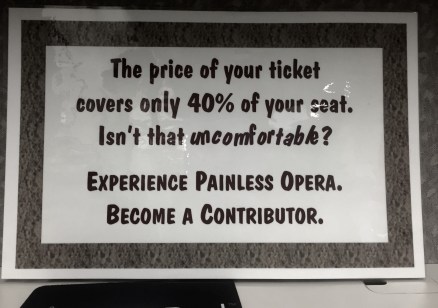
Here is a typical Case for Support in the Arts:

Some version of this message (Your Purchase is Inadequate) is an almost universal rationale for support in Arts and Culture. Why in the world?

The thinking goes something like, “Friend, the cost of your ticket (that you paid for with your hard earned money at the price we proposed) ACTUALLY ONLY REPRESENTS a fraction of the true cost of producing the performance for which you’ve joined us this Evening. And so you, as a Decent Person, should be wracked with Regret for not paying your fair share. And so Give Us Your Money. You misanthrope. You fiend. You Cheapie.”

And I don’t buy it. This is a terrible way to inspire Giving.

Why don’t you simply raise ticket prices?

That’s my natural question. You said it was $25 to see this funny play with good lighting and I paid for my ticket. Would I have paid $55, representing the true cost of attendance? Probably. For most of us, the cost of an entertainment is generally not the barrier to attendance versus other opportunities: having dinner at the new Kale place, going to that party at Renee’s, watching HBO at home, and so forth.

The performing arts tend to have a wealthier than average audience base compared with other forms of entertainment. Most of the crowd could pay more. Look around at the next play, opera or orchestra performance you attend. So, is your Case for Support, is to subsidize ticket prices for old, rich folks? I didn’t think so.

The “Your Seat Costs” rationale is based on Guilt, first and foremost. Does Guilt work to get people to act? Of course it does. But is it the best way to inspire joyful giving? I don’t think so. Guilt doesn’t lead to long-term affinity nor loyalty. You made me feel bad. Good for you. Here is $25. Take me off your solicitation list.

Finally, making your philanthropic case about the “true cost” of production suggests entertainment is all your organization is about. I love theatre and see everything I can. But if I, as a patron, only see value in your organization as entertainment, you’ve missed a real opportunity to connect with me in a more meaningful way. If a ticket to me is simply a transaction, a fee paid for a service of entertaining me for the evening, I will be no more connected to your arts organization than I am to the IMAX theatre where I am going to go see Star Wars next month.

So what instead? Tickets to performances are for my personal enjoyment and joyful consumption. Invite my philanthropy by telling me about your work beyond the stage. Those education programs that introduce youngsters to their first Shakespeare and the acting classes that teach self confidence and self reliance to teenagers. Share with me the value of having professional working artists in my community. Tell me about creating new works that showcase the faces and stories of our increasingly diverse city.

This is what inspires loyal philanthropy. Asking patrons to pony up cash because their tickets should have cost more is beneath all of us in Arts and Culture. It is lazy, manipulative and dreary. 

Can we agree to stop?

Posted in Fundraising, Performing Arts, Philanthropy | 45 Comments

Monday After the Gala.

Dixon Digital-763

Fall is upon us and in addition to football and PSL, it is High Gala Season from Albany to Alaska. I hope yours is a terrific success, filled with More Fun and More Sharing. I love Galas more than many straight, white, middle aged-ish fellows, due no doubt to an upbringing in the arts and as someone who enjoys a good looking party. Gentlemen, buy yourself a tuxedo and have it tailored correctly. Rentals don’t serve for a fully grown man. Prom was a long time ago, Bro.

A dear friend from a prior career stop reached out recently, flush with success from the most successful Gala to date for her young organization, including a new (and quite extraordinary) paddle auction that raised a pile of cash.

Bravo!” I replied, “So what does Monday look like?”

Monday After the Gala and the days that follow are some of the most critical times in your fundraising year. If you’ve done the job, your Gala night has energized key stakeholders, introduced your mission to a new prospect pool, and raised a good chunk of cheddar for your operating budget. If you haven’t and missed the revenue target, all the more reason to get back on track with your work.

The weeks prior to Gala have been consumed your team (locust like) with table seating, auction organization, menu struggles, endless trips to Target, and hanging decorations for the Young Person’s After Party. All of this has left your staff team and volunteers in a puddle, worn out and strung out. Ready for a break. But you cannot with this which makes the days after the Gala so precious to the year’s ultimate fundraising success.

Where to begin?

  1. Take the morning off. The Monday After the Gala should start after 1pm. Let everyone have the morning to sleep in and catch up on life’s business. Managing people is difficult. Nothing builds loyalty from a staff like the magic, “Thanks for tonight and for working so hard on this as a team. I will see everybody Monday afternoon.”
  2. Document. Staff members are having terrific conversations with prospects and donors, learning new things and advancing relationships, but unless it is documented into your system (whatever that system is) it might as well not have happened.
  3. Loop in your key volunteers to assess the lessons learned from the event but more importantly to document (similarly) the conversations. Who raised a hand during the paddle auction with gusto? Who was crying at the story of the Labrador puppy that learned to read while Mozart played? Who said, “I want more of this“?
  4. Set action steps for key prospects. This is the most critical of all. We assemble the right people in a ballroom, get them jazzed, generous and dancing, and then we forget about them on Monday. Events should be thrown to engage new prospects and donors into the cultivation pipeline. Otherwise there are far more effective ways to raise money like $5,000 low carb lunches, right?
  5. Start the Thank You process, in a hurry. We tend to forget to thank donors who participate in events, buy auction items, etc. because these are not traditional contributions to the annual fund. Your donors probably don’t think of it that way. Whatever fund code the gift goes into, start thanking people as if they gave an unrestricted gift. How would I react if someone called me in thanks for attending a fundraising event? I don’t know. It has never happened.
  6. Get back on track. Your fundraising plan has probably suffered from the Gala. Direct mail #2 is late, the individual gifts committee meeting was cancelled, and the corporate gifts team spend the last month selling gala tables. So you are behind. Get back on the Annual Fund Bus immediately. It cannot wait one more day.

Happy Gala Season. Save me a dance, and I shall have the duck.

Posted in Fundraising, Performing Arts, Philanthropy | Leave a comment

When fundraisers Blow It. 

I often query fundraising candidates with, “Describe a time where you blew it with a donor.” It is a telling response when the candidate cannot immediately point to a specific time where she made a mess of a solicitation or relationship with a major donor. Fundraising is challenging work with high stakes. If you haven’t made a serious mistake along the way you are likely huddled in your office, hanging out with the grant writer, and never, ever asking actual people for actual money.

I also ask because I am curious how the candidate responded to the failure, what she did to fix the mistake, and what lessons were learned for the next time.

One of my favorite non-profit voices on Twitter is The Whiny Donor. She is a philanthropist and a thoughtful, articulate scold to our business of philanthropy. We need her voice, and many more like it, in the worst way. I don’t always agree with her but I give pause when she challenges our typical practices.

Here is her must read essay, the key message being, “Sooner or later you are going to blow it with a donor like me…” Donors, like the rest of us, can be prickly and have unrealistic expectations. But ignore their critique at your peril. Her specific examples will make your skin crawl…The “Dear Supporter” letter addressed to a loyal donor of 24 years and a gift officer who passed the buck to a subordinate…Yuck.

Being mistreated by a non-profit after a meaningful gift feels lousy. I’ve stepped up my philanthropy in recent years and it hasn’t always been fulfilling, compared with the immediate gratification of new wireless headphones, when no one calls to thank me, written acknowledgements don’t arrive, and my name is misspelled. I give money to solve problems and invest in community. Feeling sore at a non-profit sucks.

As a donor, I completely understand The Whiny Donor’s willingness to walk away from support after she complains about something and doesn’t receive an adequate response. But it’s not typical. The reality is that most donors won’t bother to complain to you directly. They will simply ghost away and you won’t ever see another $1.

Bless the donors willing to share frustrations with your organization because you are going to make mistakes, screw things up, misprint names and forget to mail the thank you letters on occasion. What do we do when they call?

  1. Listen. Take any complaint or constructive feedback with real sincerity. You might not agree with the premise or degree of injustice suggested. That’s okay. I happen to believe in (and champion) robust fundraising tactics like telefundraising and multiple solicitations per year (if well designed and carefully segmented). But I will surely listen to a donor who feels otherwise, and offer a solution like putting someone on a no call or one solicit per year list.
  2. Apologize. If you signed the letter, don’t pass along the complaint downstairs. If you are the Boss, be the Boss. Accept responsibility. Explaining that you are SORRY seems like a forgotten skill these days. Practice. Say that you are sorry and mean it. Start at home tonight. You did something.
  3. Fix the Problem. Don’t say, “I am sorry that you are disappointed” passive aggressively like Delta Airlines. Say, instead, “I acknowledge this issue. You have my sincere apology. If you permit me, I will make this right.” 

We donors invest in non-profits to have impact, to feel good about being a human, out of obligation, and for many other legitimate reasons. Our first job as fundraiser is to Do No Harm with donor relationships. We can start by being humble, sincere and apologetic when we inevitably make a mistake.

Posted in Fundraising, Leadership, Philanthropy | Tagged , , , , | 1 Comment